Calculator Guide

How to use the Australian calculator

Follow the controls in the order they appear, then check the public holidays, settings and excluded dates. This page explains the tool; Use Cases show completed setups and Articles explain the source rules and annual holiday dates.

Last reviewed: July 2026

Step 1

Choose the calculation you want to run

At-a-Glance

  • Default Mode handles one deadline or the difference between two dates
  • Court Rules applies a selected Australian court profile
  • Sequential Periods joins two or more user-defined stages

Start with the job you need the calculator to do. The mode cards change the controls below them.

Default Mode

Use this for a standard working-day or calendar-day count, a supported industry preset, or a conveyancing count.

Court Rules

Use this when you have identified the Australian court, step, start date and period.

Sequential Periods

Use this when one known period finishes and another known period begins.

Check the source before setting up the calculator

The calculator cannot choose the start event, period, court, contract clause or SOPA rule for you. Find those details in the rule or contract, then enter them here.

Try it as you read

The three mode cards appear at the top of the form.
Open the calculator

Default Mode

Run a standard working-day or calendar-day count

At-a-Glance

  • Choose Deadline when you know a start date and a period
  • Choose Difference when you already know both dates
  • Set both boundary checkboxes from the wording of your source

Select Default Mode, then work down the form in the order shown.

Australian calculator in Default Mode with a 15-working-day NSW calculationOpen full size
Default Mode configured for a forward NSW working-day count. Select the image to open the full-size view.
Calculation Mode
Choose Deadline to calculate a date. Choose Difference to count between two dates.
Direction
Choose Forward to add the period or Backward to count back from an event date.
Calendar days
Leave this off for working days. Turn it on when the period is stated in calendar days, weeks or months.
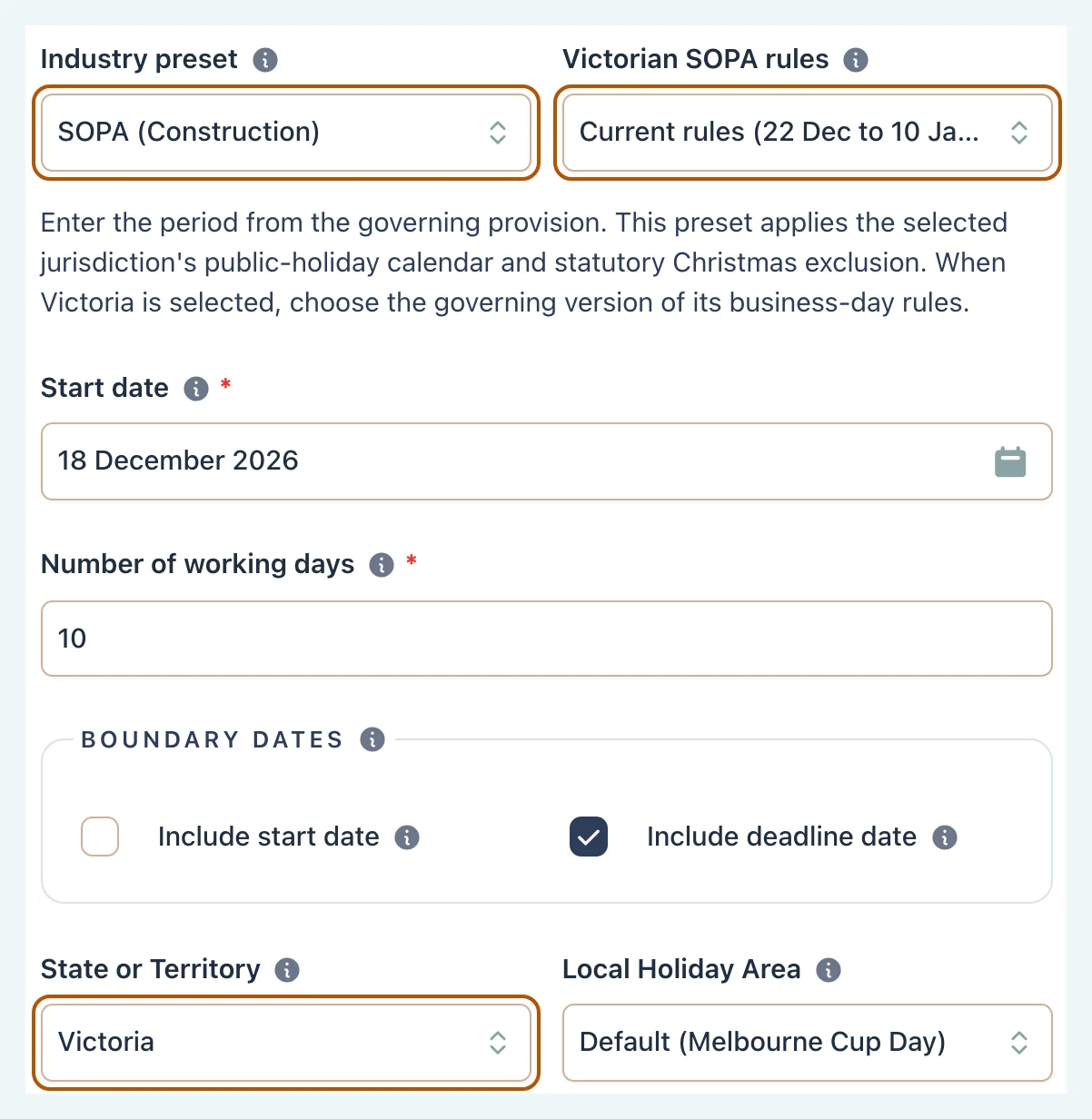
Industry preset
Leave Standard selected unless you need the supported SOPA, Conveyancing or Employment/HR setup.
Start Date and Number of days
Enter the trigger date and the period supplied by your contract, rule or process.
Include start date
Turn this on only when the first date is day 1.
Include deadline date
Keep this on when the calculated date itself completes the period.
State or Territory
Choose the state or territory whose public holidays apply under the rule, contract or workplace policy. It may not be the employer's head office or your current location.

A three-day boundary check

Start on Monday and enter 3 calendar days. If Monday is excluded, the count is Tuesday, Wednesday, Thursday. If Monday is included, it is Monday, Tuesday, Wednesday. Use this small check when your answer is one day out.

Public holidays

Select the state, territory and local holidays

At-a-Glance

  • State or Territory selects the public holidays that apply
  • Local Holiday Area appears where the calculator supports a more specific profile
  • A coverage warning means you must check the current official table

Select the state or territory first. If more specific local holidays are available, the calculator then displays Local Holiday Area.

Queensland selected with the Local Holiday Area control visibleOpen full size
Queensland with Brisbane (Ekka) selected as the local holiday area. Select the image to open the full-size view.
State or Territory
Choose NSW, VIC, QLD, WA, SA, TAS, NT or ACT. Federal appears where the calculation supports a federal profile.
Local Holiday Area
Choose a Queensland or Northern Territory show-day area, a Victorian annual alternative, or Tasmania North/South when those local holidays apply.
Warnings
Read every warning. If a local date is missing for the selected year, the result explains what is missing and whether the statewide holiday is still included.
Analysis
After calculating, check the state, territory or local area shown in the result. Do not rely only on the form selection.

Missing annual data is not a zero-day answer

A missing-year warning means the calculator does not yet have a verified local date for that year. Check the official district table before using the result.

For example, select Queensland, Gold Coast Show and a date in 2028. The warning says that no 2028 Gold Coast show date is stored, Brisbane's Ekka is not used, and no local replacement has been added. Check the official Queensland district table before treating that date as a working day.

Court deadlines

Set up Court Rules Mode

At-a-Glance

  • Choose Notice to count backward or Filing to count forward
  • Select the court jurisdiction before entering the period
  • Turn on Use clear days or a vacation control only when the rule requires it

Select Court Rules only after identifying the court and rule. The form displays the counting method and any optional controls for your selection.

Australian Court Rules Mode configured for a Victorian filingOpen full size
Court Rules Mode with Filing selected and Use clear days left off. Select the image to open the full-size view.
Notice or Filing
Choose Notice to count backward from an event. Choose Filing to count forward from service or another trigger.
Court Jurisdiction
Select the court profile named in your rule. This is separate from the ordinary holiday selector.
Court Level or Registry Location
This appears where a jurisdiction has different court levels or registry closure dates. Select the office or level required for the step you are timing.
Use clear days
Leave this off for the profile's ordinary boundary settings. Turn it on only when both the trigger date and calculated date must be excluded.
Optional court control
A vacation or document-specific exclusion appears only for profiles that support it. The tooltip explains its scope.
Number of days
Enter the period from the rule. The selected profile decides whether a short period changes the counting method.

Compare ordinary boundaries with clear days

Select South Australia and Notice. Enter Wednesday 14 January 2026 as the event date and 2 days. With Use clear days off, the service date is Monday 12 January. Turn it on and both boundary dates are excluded. The calculated date falls on Sunday 11 January, so the result moves back to Friday 9 January.

Topic

Use the SOPA preset

Enter the SOPA period and state or territory, including the Victorian rule version where required.

Topic

Use the Conveyancing preset

Choose the scenario and decide whether the optional contract-date exclusion applies.

Topic

Build sequential periods

Set up and review each documented stage before running the combined calculation.

Check the answer

Read and verify the result

At-a-Glance

  • Start with the calculated date, then read the Analysis section
  • Open Excluded Dates and check the timeline
  • Treat every warning as an action item

Do not stop at the headline date. The result records the assumptions that produced it.

Australian calculator result showing analysis, breakdown and timelineOpen full size
A Court Rules result with the assumptions and excluded dates visible. Select the image to open the full-size view.
Calculated date
Confirm the date and weekday first.
Analysis
Check the start event, direction, period, state or territory, counting method, shutdown and boundary settings.
Working / Weekend / Holidays / Shutdown
Check that these totals match the timeline. A part-day holiday may appear without removing the whole date.
Applied controls
In Court Rules and industry modes, confirm any optional rule control or rule-version choice recorded by the response.
Excluded Dates
Open the list and check each public holiday, local holiday, court closure and shutdown date.
Warnings
Deal with missing local dates, unsupported combinations and other warnings before using the result.
Export to PDF
Export only after checking the assumptions. The PDF records the calculation; it does not validate the source rule.

Check a complete calculation

Use a scenario to confirm how the result is presented.
Compare with a use case

Topic

Troubleshooting

Find the setting most likely to explain an unexpected result.